
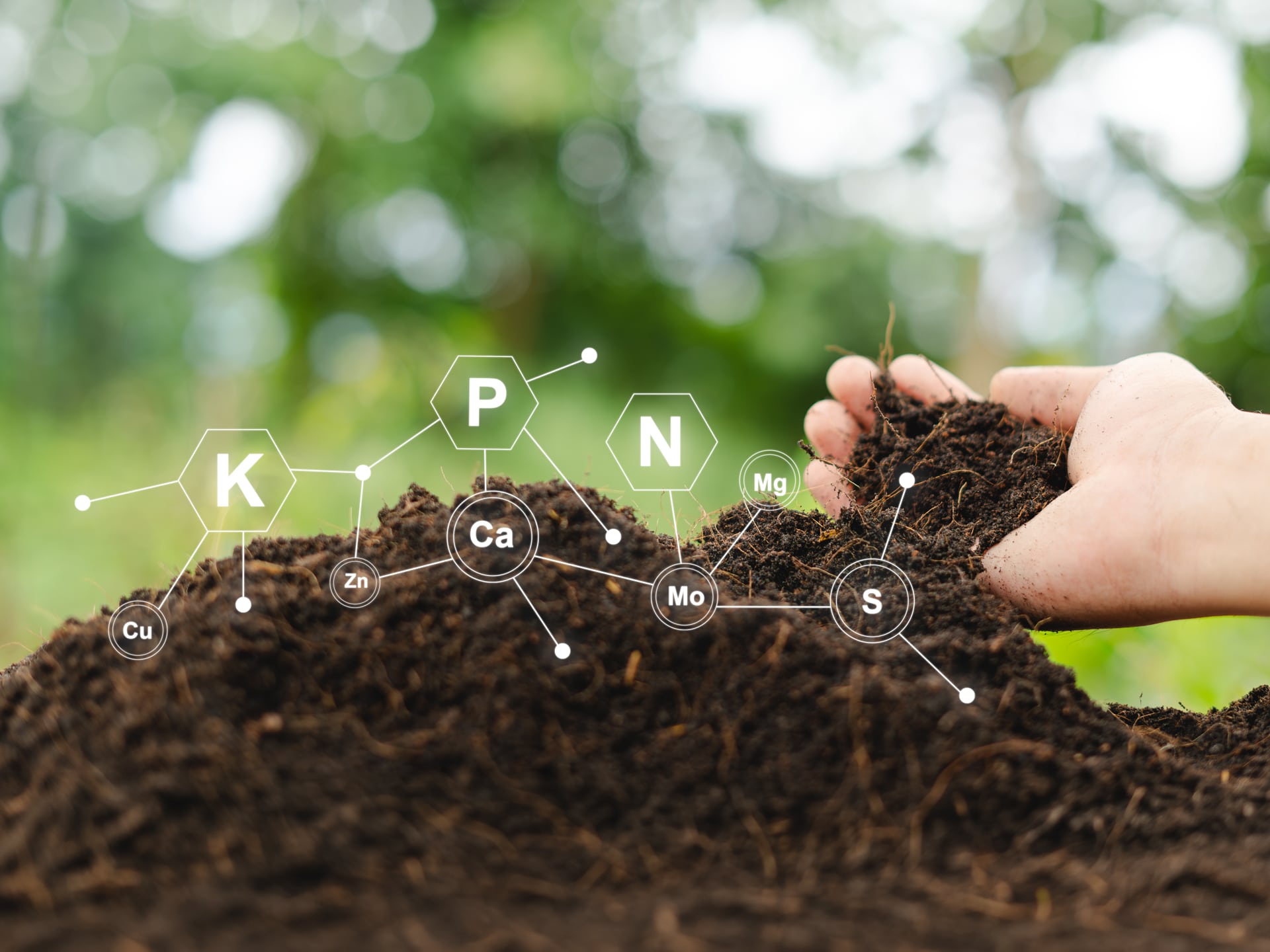
Plants need nutrients to survive and grow. They absorb nutrients from the soil through their roots and root hairs in the form of dissolved ions, while also producing energy through photosynthesis using sunlight, water, and carbon dioxide. Nutrient availability can be affected by soil pH, drainage, soil type, temperature, and excessive rainfall.
Fertilizers supply essential nutrients that fall into three groups: primary macronutrients (Nitrogen, Phosphorus, Potassium), secondary macronutrients (Calcium, Magnesium, Sulfur), and micronutrients (including Boron, Iron, Zinc, and others). Each plays a specific role in supporting plant health, growth, and development.
Primary Macronutrients
- Nitrogen (N) supports leaf growth, protein formation, and chlorophyll production.
- Phosphorus (P) promotes root development, flowering, fruiting, and energy storage.
- Potassium (K) strengthens roots and improves resistance to disease, pests, drought, heat, and cold.
Secondary Macronutrients
- Calcium (Ca) supports root growth and strengthens cell walls.
- Magnesium (Mg) aids nutrient uptake and is a key part of chlorophyll.
- Sulfur (S) contributes to root formation, cell structure, and stress tolerance.
Micronutrients
- Boron (B) supports root growth and pollen development.
- Chlorine (Cl) helps regulate water movement and nutrient transport.
- Copper (Cu) aids photosynthesis and seed production.
- Iron (Fe) is critical for chlorophyll production and energy processes.
- Manganese (Mn) supports enzyme activity and photosynthesis.
- Molybdenum (Mo) helps plants utilize nitrogen.
- Nickel (Ni) supports enzyme function and seed production.
- Zinc (Zn) aids root development and chlorophyll formation.
Plants also rely on carbon, hydrogen, and oxygen from air and water as the basic building blocks for growth.
Fertilizer bags display N-P-K numbers, such as 10-6-4, which represent the percentage by weight of each nutrient. Ratios are also used, meaning fertilizers like 15-10-5 and 30-20-10 share the same proportional balance. This is helpful when comparing organic and synthetic options with different analysis numbers.
Synthetic fertilizers provide nutrients quickly and are available in liquid or granular forms, but they can burn plants if overapplied and may leach from the soil. Organic fertilizers release nutrients more slowly as soil microbes break them down, making them safer for plants and longer lasting in the soil. Many organic products also contain mycorrhizae, beneficial fungi that form a symbiotic relationship with roots and improve nutrient uptake.
When choosing a fertilizer, look at both the N-P-K and the product label. Blends are designed for general use or specific plants, and fertilizers with a higher middle number (phosphorus) are typically used to promote flowering.